Table of contents
Bangkok’s festival calendar has become one of Southeast Asia’s most revealing cultural barometers, and not only for tourists seeking spectacle. From temple fairs to street processions, the capital now hosts an almost continuous rotation of public rituals where old beliefs, new identities, and a fast-changing city negotiate space in real time. Visit Thailand and you quickly learn that festivals here are not decorative extras, they are how communities organise memory, trade, faith, and politics, and Bangkok is the place where every thread of that national tapestry seems to knot together.
Bangkok’s festivals are a living map
What does a city’s calendar tell you about its soul? In Bangkok, it tells you almost everything. The capital’s most visible celebrations draw from Thailand’s major cultural layers, Buddhist merit-making and royal-era ceremony, Chinese-Thai commerce and migration, and regional traditions carried in by internal movement from the North, Northeast, and South. That mix is not theoretical, it is observable on the street, where festival routes cut through neighbourhood economies and where sacred spaces sit next to malls, expressways, and condominium towers.
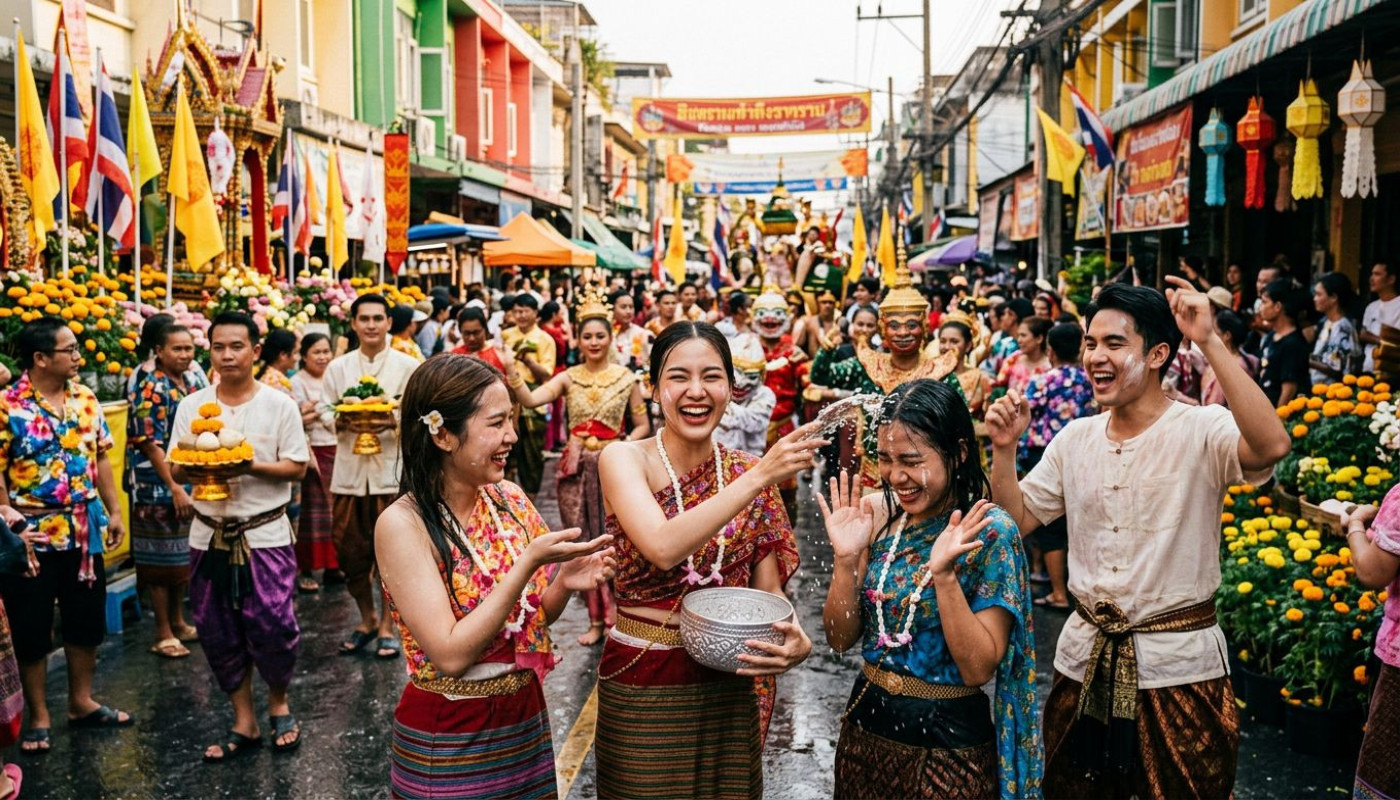
Take Songkran, the Thai New Year in mid-April, officially marked nationwide, yet most fiercely negotiated in Bangkok. The traditional act, gently pouring water to honour elders and Buddha images, still anchors temple events and family gatherings; at the same time, the capital’s tourism-heavy districts have popularised the high-energy street “water fights” that now dominate global images of the holiday. The shift reflects Bangkok’s role as both national stage and commercial amplifier, and it underlines a key point for visitors: the same festival can mean different things within a few kilometres, depending on whether you are near a wat, a residential lane, or a nightlife strip.
Loy Krathong, typically in November on the full moon of the 12th lunar month, adds another layer. The floating of small offerings on waterways, often framed as an apology to the water goddess and a gesture to let go of bad luck, carries spiritual and environmental undertones, and in Bangkok it forces attention back to the city’s relationship with water, canals, drainage, and flood risk. Even when celebrations move to controlled venues along the river, the symbolism remains tied to the capital’s hydraulic reality, and the festival becomes an annual reminder that Bangkok’s modern infrastructure still depends on the rhythms of the Chao Phraya basin.
Chinese-Thai festivities, including Lunar New Year in Yaowarat, reveal Bangkok as a migration city. Thailand has one of the largest overseas Chinese communities in the world, and Bangkok’s Chinatown is not a museum, it is an economic engine and an evolving identity space. During Lunar New Year, the red lanterns, offerings, dragon dances, and crowded food stalls are more than photogenic; they represent networks of trade, kinship, and philanthropy, and they show how Thai national identity has long been shaped by cultural borrowing rather than cultural purity.
Street processions, big money, bigger stakes
Follow the music, and you will find the economy. Bangkok’s major festivals mobilise huge numbers of vendors, performers, organisers, and transport services, and they also pull in hotel nights, restaurant covers, and retail footfall in ways that can shift entire districts. Even without a single official “festival season,” the city’s event-driven surges are predictable: April for Songkran, late-year for Loy Krathong, and multiple peaks around Lunar New Year and major Buddhist holidays. For a metropolis that lives on consumption, those peaks matter, and local businesses plan staffing and stock around them.
Yet the stakes are not only commercial, they are civic. Festivals concentrate crowds, amplify noise, and stress public space, which means they quickly become a test of governance, policing, and infrastructure. Bangkok has repeatedly had to balance celebration with safety, and every high-attendance event raises the same practical questions: where do crowds enter and exit, how do emergency services move, what happens when rain hits, and how does the city manage alcohol, road closures, and public transport capacity? In a dense urban environment, “fun” is never just fun; it is logistics, and logistics is politics.
The tension is visible in how different zones of the city are curated. Authorities and communities often steer the rowdiest forms of celebration toward certain corridors, while temples and residential areas preserve more restrained rituals. That split shapes the visitor experience: you can choose immersion in communal rites, or you can choose the mass spectacle, but understanding Bangkok means noticing the line between them, and how it shifts over time. The city’s festival geography also tracks gentrification, as some historic neighbourhoods become fashionable, rents rise, and long-standing communities struggle to maintain their cultural footprint.
For travellers, the best reporting tool is curiosity. Ask who organises an event, who benefits, who is inconvenienced, and who is being pushed out. You will start to see festivals as arenas where Bangkok renegotiates itself, and you will also make better choices about where to spend your time and money. For planning tips, neighbourhood context, and ideas to build an itinerary around local culture without reducing it to a checklist, many visitors begin with https://www.bangkok-spirit.com/, then cross-check dates and locations with official announcements as they firm up travel plans.
Beyond the postcard, the rituals still bite
Forget the glossy montage. Bangkok’s most compelling festival moments are often the least cinematic: a quiet line of worshippers offering flowers, an elderly neighbour receiving water poured gently over their hands, or a family buying incense at a corner stall that has served the same alley for decades. These gestures can feel small, yet they carry the core of Thai social ethics, respect, reciprocity, and a sense that merit is both spiritual and communal. In a city that moves fast, festivals slow time down, and that pause is part of their power.
That power also comes from contradiction. Bangkok is deeply Buddhist in its public imagery, but it is also pluralistic in practice, and festivals bring that pluralism into view. Hindu-Brahman influences remain embedded in Thai court traditions and in certain ceremonies; Chinese folk religion and Taoist elements surface during Chinatown events; regional spirit beliefs linger in neighbourhood shrines. Rather than competing, these layers often coexist, and the capital’s festival life becomes a lesson in cultural accommodation. It is one reason Thailand can feel simultaneously cohesive and diverse: the country has developed a habit of adding layers instead of erasing them.
Modernity has not dissolved these traditions, it has reshaped their form. Social media now dictates where crowds gather and which rituals become “must-see,” and commercial sponsors sometimes influence staging, lighting, and performance schedules. At the same time, Bangkok’s younger generations frequently use festivals to express identity in contemporary ways, through fashion, music, and public creativity, while still engaging with family obligations and religious frameworks. The result is not a loss of authenticity, it is a new version of authenticity, negotiated in public, with smartphones raised, and with elders watching closely.
Visitors who treat festivals as cultural documents, not just entertainment, often leave with sharper insights into Thai society. Watch what people do at temples, notice how offerings are arranged, listen for the rhythms of language switching between Thai, Teochew, Mandarin, and English in different quarters, and pay attention to who cleans up afterwards. Cultural meaning is not only in the parade, it is in the labour, the etiquette, and the shared assumptions that keep the celebration legible to everyone around you.
How to experience it without getting in the way
Want to blend in quickly? Start with timing and manners. Bangkok festivals can be exhilarating, but they also operate on local expectations, dress codes near religious sites, norms around photographing worshippers, and basic rules about personal space in crowded areas. If you plan to visit a temple during a holiday, modest clothing is not optional, it is part of the social contract, and it will shape how you are treated. When in doubt, observe first, then act, and remember that the most respectful visitors are often the ones who speak the least and watch the most.
Next, plan for the city’s practical realities. Bangkok’s heat can be punishing during April celebrations, so hydration, sun protection, and realistic walking distances matter, and for events near the river or in old neighbourhoods, expect uneven pavements and limited vehicle access. Public transport can be the decisive factor: the BTS Skytrain and MRT are often the fastest ways to approach major gathering areas, while taxis may get trapped behind road closures. If you are travelling with children or older relatives, identify exit routes and quieter side streets before the crowd thickens; it is a simple step, yet it changes the entire experience.
Spending choices also shape impact. Buying from local vendors, eating in long-standing family-run shops, and choosing community-led events over purely staged spectacles can distribute benefits more fairly, and it can preserve the neighbourhood ecosystems that make Bangkok’s festivals worth attending in the first place. If an event is heavily promoted for “Instagrammable” moments, consider arriving early, staying aware of resident access, and avoiding behaviour that blocks doorways, shrine entrances, or procession paths. In Bangkok, the line between participant and obstacle is thin, and good travellers learn to read it.
Finally, keep your calendar flexible. Festival dates can depend on the lunar calendar, and local conditions can change plans; checking official tourism and city announcements close to departure remains essential. Many seasoned visitors build a trip around one anchor event, then leave room for serendipity, because Bangkok’s most memorable celebrations are sometimes the ones you did not plan, a neighbourhood fair, a temple anniversary, or a street performance that appears, draws a crowd, and vanishes before you can name it.
Your practical checklist before you go
Book early if you are travelling for Songkran or Loy Krathong, because central hotels and riverside rooms often climb in price as dates approach, and consider staying near a BTS or MRT station to avoid road-closure stress. Set a daily budget that includes transport and cash for small vendors, as many stalls still operate cash-first during crowded events.
Check eligibility for any tourism promotions or domestic travel schemes if you are a regional visitor, and confirm festival timings on official channels a few days before attending. Pack light, bring a reusable water bottle, and plan a meeting point if your group gets separated; it is simple preparation, and it preserves the joy when Bangkok turns the streets into a celebration.
Similar